Call us
Ball End Milling
The research activity in the field of milling processes has been focused on the analytical modelling, simulation, experimental investigation, and optimization of ball-end milling operations for the machining of complex three-dimensional surfaces. The work combines manufacturing science, CAD/CAM technologies, process simulation, surface metrology, and statistical analysis, aiming at the development of advanced methodologies for predicting and improving the quality of machined components.
A major research direction concerns the study of surface generation mechanisms during ball-end milling. Special emphasis has been placed on understanding the influence of tool geometry, cutting kinematics, machining strategy, and process parameters on the resulting surface topography and roughness. The objective has been to establish reliable relationships between machining conditions and the geometrical characteristics of the produced surface, enabling the optimization of finishing operations in high-value industrial applications.
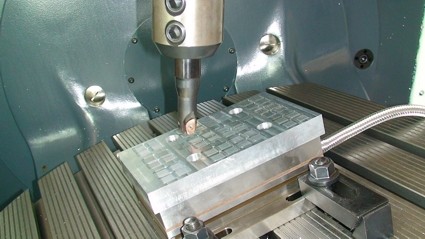
One of the key contributions of this research has been the development of analytical and computational simulation models capable of predicting the surface topomorphy produced during ball-end milling. Advanced mathematical formulations were developed to accurately represent the movement of the cutting tool, the interaction between the cutting edges and the workpiece, and the resulting material removal process. These models provide detailed information regarding the generated surface profile, surface roughness, undeformed chip geometry, and cutting kinematics. The simulation environment allows engineers to evaluate alternative machining conditions prior to production, significantly reducing the need for costly experimental trials.
A dedicated software platform was developed for the simulation of ball-end milling processes. The software incorporates detailed representations of cutting tool geometry, workpiece discretization, tool trajectories, and machining parameters. Through numerical calculations and graphical visualization, the system predicts the resulting surface morphology and roughness characteristics under a wide range of machining conditions. Experimental validation performed using multi-axis CNC machining centres demonstrated excellent agreement between simulated and measured results, confirming the accuracy and industrial applicability of the developed methodology.
Another important research area has involved the investigation of milling strategies and their influence on surface quality. Extensive experimental studies were conducted to evaluate different machining approaches, including vertical milling, push milling, pull milling, oblique milling, oblique-push milling, and oblique-pull milling. The effects of feed rate, axial depth of cut, radial depth of cut, tool inclination angles, and cutting direction were systematically analyzed through large-scale experimental campaigns. Statistical tools such as regression analysis and analysis of variance (ANOVA) were employed to establish mathematical models capable of predicting surface roughness for each machining strategy.
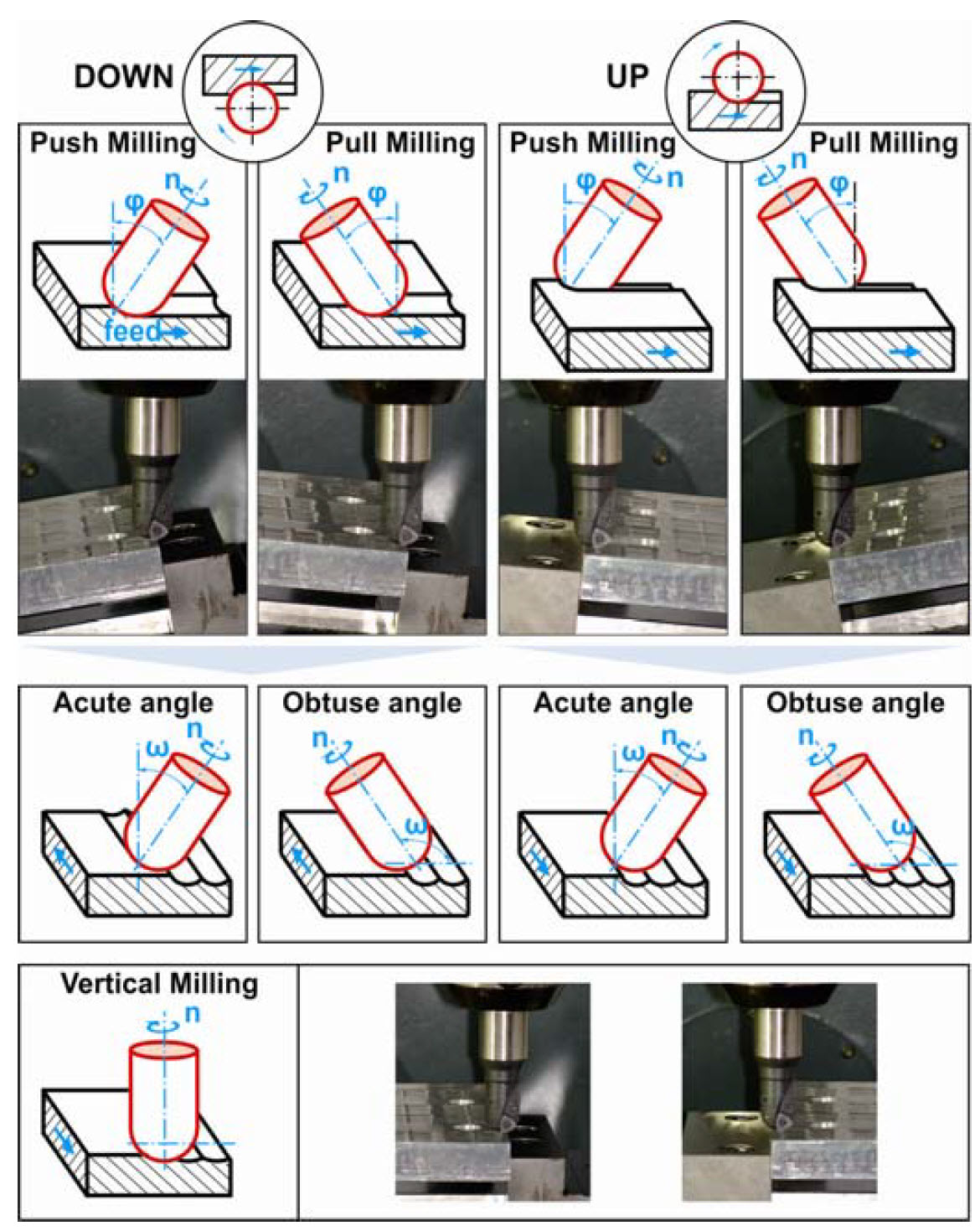
The research demonstrated that machining strategy has a significant impact on the final surface quality and that appropriate selection of tool orientation and cutting conditions can substantially improve surface finish. Third-order predictive models were developed and experimentally verified, providing valuable tools for process planning and optimization in industrial milling operations. These models enable the selection of optimal cutting parameters based on desired surface quality requirements and productivity constraints.
A further extension of this research has focused on micro-ball-end milling, addressing the growing industrial demand for the manufacture of miniature components with high dimensional accuracy and superior surface integrity. In this field, CAD-based simulation methodologies were developed using parametric three-dimensional modelling environments. The simulation framework incorporates the complete kinematics of micro-milling operations and generates detailed three-dimensional representations of the resulting surface topography.
Special algorithms were developed to calculate roughness parameters directly from the simulated surfaces according to international metrology standards. The methodology enables the prediction of roughness parameters such as Ra, Rz, and Rt, providing a direct link between machining parameters and surface quality. Experimental investigations on aluminium alloys using high-speed micro-milling systems verified the capability of the developed models to accurately reproduce the characteristics of the machined surfaces.