Call us
Drilling
This research activities focus on the development of advanced numerical simulation methodologies and experimental validation techniques on drilling operations. The primary objective of this work is to improve the understanding of cutting mechanics, optimize machining parameters, and enhance the quality and accuracy of manufactured components through the integration of computational modeling and experimental investigations.
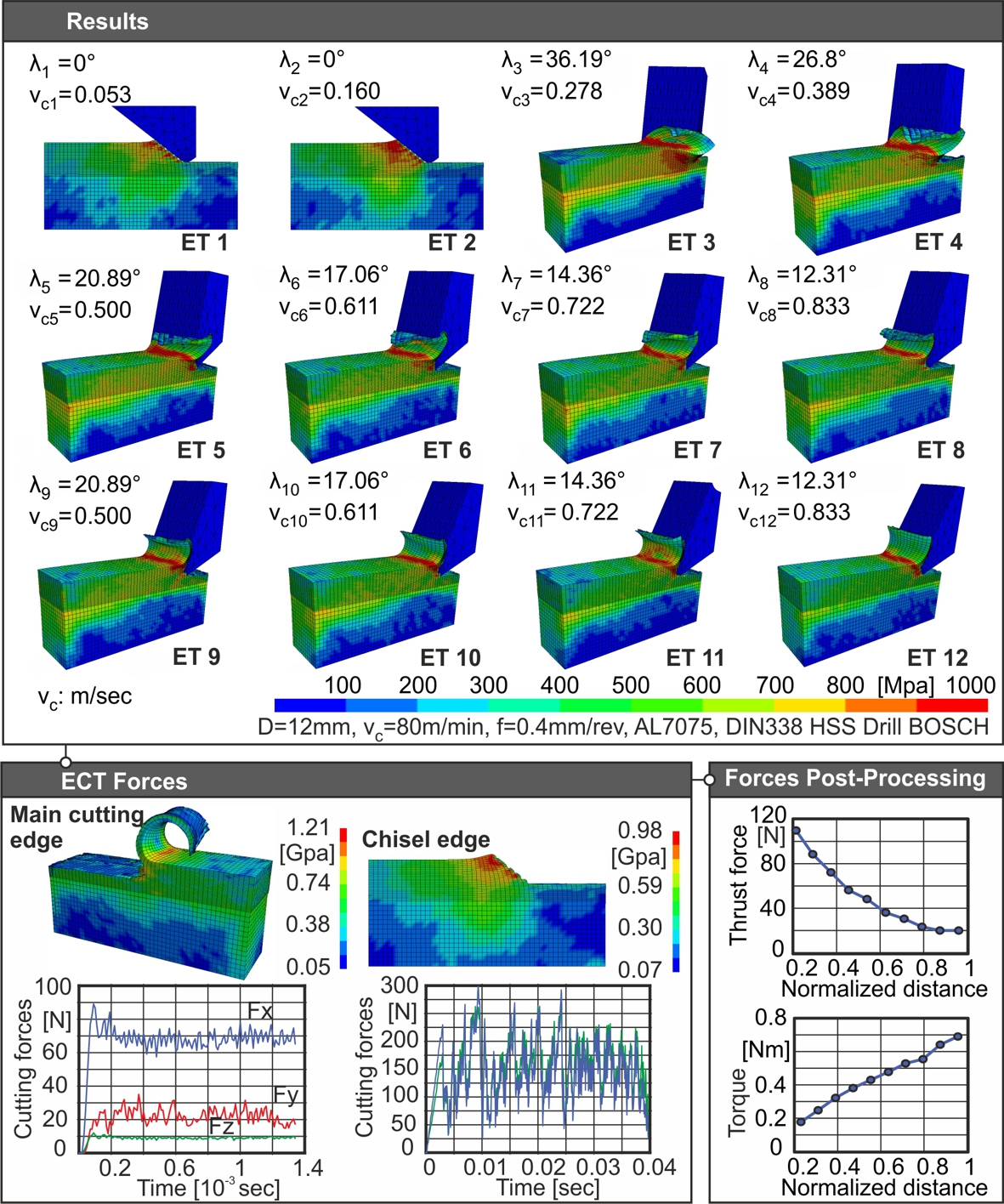
A significant outcome of this research is the development of DIATRISIS, an innovative drilling simulation software that combines finite element analysis, parametric tool modeling, and automated metrology. The software introduces a novel approach for drilling simulation by decomposing the drill cutting edges into a series of elementary orthogonal and oblique cutting models. This methodology significantly reduces computational cost while maintaining high prediction accuracy for cutting forces, torque, stress distributions, and hole quality characteristics.
The research involved the creation of advanced parametric models capable of automatically generating various drill geometries, analyzing tool characteristics, and producing finite element sub-models suitable for machining simulations. Particular attention was given to the prediction of thrust force distribution along the cutting edges, the contribution of the chisel edge, and the influence of tool geometry and cutting conditions on machining performance.
Extensive finite element simulations were conducted, incorporating advanced material constitutive models and sophisticated contact algorithms to accurately represent chip formation and material removal mechanisms. The numerical predictions were experimentally validated through drilling tests performed on CNC machining centers using multi-component dynamometers and precision measurement systems. The comparison between simulated and measured cutting forces demonstrated very good agreement, confirming the reliability and robustness of the developed methodology.
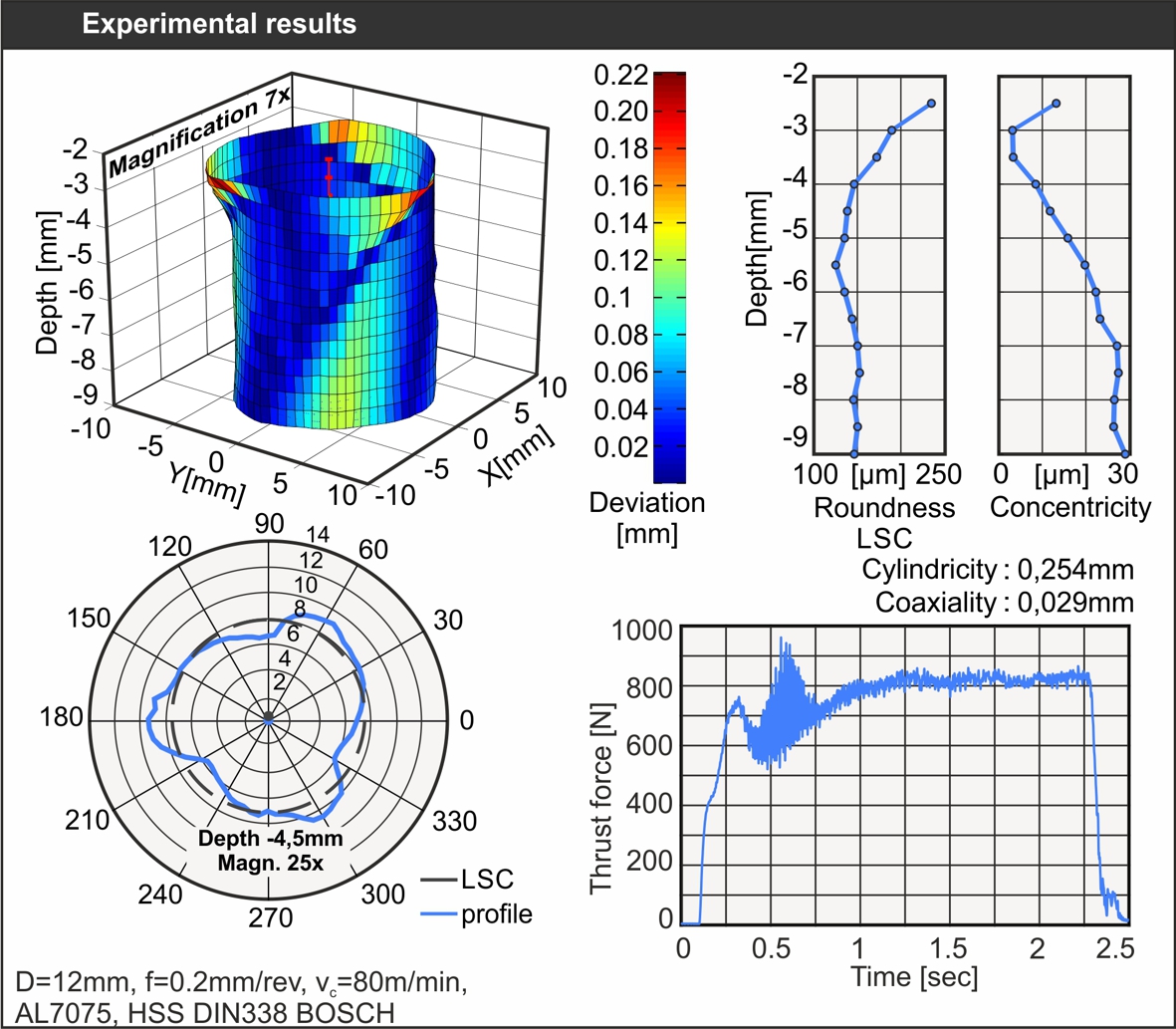
An additional research contribution concerns the development of automated hole-quality evaluation techniques. Specialized software modules were created for the measurement and analysis of geometric characteristics such as roundness, concentricity, coaxiality, and cylindricity according to international GPS standards (ISO 1101 and ISO 12180). Automated measurement procedures were developed to acquire thousands of measurement points directly from CNC machine tools, enabling detailed three-dimensional characterization of drilled holes and comprehensive assessment of machining quality.
The outcomes of this research contribute to the fields of machining process simulation, manufacturing optimization, computer-aided engineering, and dimensional metrology. The developed methodologies provide valuable tools for industrial applications involving process planning, tool design, quality control, and optimization of drilling operations. Furthermore, the research establishes a framework that can be extended to the simulation and analysis of other machining processes, supporting the advancement of intelligent manufacturing and digital engineering technologies.
Another research activity focuses on the investigation and prediction of burr formation mechanisms during drilling operations through the combined use of finite element modeling and experimental validation techniques. The work involved the development of an advanced numerical model capable of simulating material deformation and burr generation at both the entrance and exit surfaces of drilled holes. Particular emphasis was placed on exit burr formation, due to its significant impact on product quality, assembly performance, and manufacturing cost. Extensive drilling experiments were conducted on aluminum alloys under various cutting conditions, while high-speed imaging and three-dimensional optical profilometry were employed to capture the burr formation process and accurately quantify burr geometry. A novel validation methodology was developed based on the comparison of experimentally observed material deformation with finite element predictions, utilizing laser-engraved reference grids and high-speed video analysis. The validated model was subsequently used to investigate the influence of cutting speed and feed rate on burr characteristics and to generate predictive maps for burr height and width, enabling the identification of optimal machining conditions. The research contributes to the fields of machining process modeling, manufacturing optimization, and quality control by providing a reliable framework for burr minimization and process parameter selection.