Undergraduate
Course Info
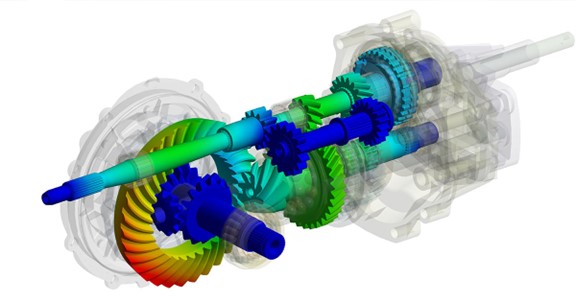
Students are taught advanced methods for the dynamic analysis of complex mechanical systems under realistic loading conditions through practical examples inspired by real-world applications, with emphasis on industry and transportation. The course adopts a project-based learning approach, structured around two assignments (one group project and one individual project), as well as numerous application examples.
Theoretical concepts and methods are introduced and analyzed through practical applications, alongside training in the use of appropriate commercial finite element software for approximate modal analysis, the evaluation of hazardous operating conditions (internal resonance), and the application of flexible methods for calculating dynamic response in the time domain.
In addition, students are trained in the development of simplified models using mathematical modeling software for the computational analysis of realistic systems with complex characteristics (e.g., nonlinear stiffness). They are introduced to vibration problems occurring in production systems (self-excited vibrations) and in power transmission systems (parametric resonance).
As a result, students acquire valuable skills for the design of mechanical products and processes, the evaluation of the vibrational behavior of mechanical systems under real operating conditions, the informed redesign and optimization of systems to avoid issues such as resonance, fatigue, and reduced performance, and the assessment of the dynamic characteristics of existing installations and components.
Furthermore, students are taught fundamental methods, tools, and equipment for the experimental vibration analysis of mechanical systems.